What is SEO?
The full form of SEO is search engine optimization. This is a process in which you optimize the structure and content of your website so that search engines (e.g. Google, Bing) rank your pages in the top positions in search results, without any paid advertising.
Whenever a user types a query on Google, he sees two types of results:
Paid results (Google Ads): Results have “Sponsored” or “Ads” written next to them. For this, business owners pay pay per click (PPC) to Google. As soon as the budget ends, traffic stops coming.
Organic results (SEO): These are the results that are most accurate, high quality and relevant according to Google’s algorithm. Google does not have to pay any money for the traffic coming on these.
In simple words, what SEO means is: making your website search-friendly so that targeted visitors can easily find you on Google without any paid campaign.
Importance of SEO
Some people wonder: if traffic can be generated through social media marketing or advertisements, why put so much effort into SEO? Here are the key benefits:
Consistent, Free Organic Traffic: With paid advertisements, traffic only lasts as long as your daily budget is active. In contrast, once you achieve a high ranking through SEO, you continue to receive steady traffic for years—without any ongoing daily costs.
Higher Conversion Rates and Intent: People often use social media just to pass the time, whereas users come to Google specifically to find a solution to a particular problem. Consequently, organic traffic tends to have a higher conversion rate than traffic from other sources.
Brand Trust and Authority: Users often place implicit trust in the top results that appear on the first page of Google. Securing a top spot on the SERP (Search Engine Results Page) naturally enhances your brand’s credibility in the market.
Higher Long-Term ROI: While SEO requires an initial investment of time, it proves to be the most cost-effective and profitable digital marketing channel in the long run.
How Search Engines Work?
To implement SEO effectively, it is helpful to understand how Google’s ranking mechanism actually works. Google’s search engine operates in three main stages:
Crawling: Google uses automated software programs known as crawlers, spiders, or Googlebot. These bots scan the internet to discover new and existing web pages, blog posts, images, PDFs, and links. When a new page is created on your site—or when internal or external links connect to it—these bots locate it.
Indexing: After crawling a page, Googlebot analyzes its content, including text, images, videos, and code. If the page complies with Google’s quality guidelines, it is stored within Google’s vast server database; this storage process is called “indexing.” A page cannot appear in search results unless it has been indexed.
Ranking: When a user performs a search on Google, the engine retrieves the most relevant and authoritative pages from its index and displays them on the screen in a fraction of a second. Google determines the ranking position by utilizing over 200 ranking factors and advanced AI algorithms.
Types of SEO
For complete website optimization, SEO is divided into three main categories:
On-Page SEO
Technical SEO
Off-Page SEO
For physical businesses, Local SEO is also equally critical.
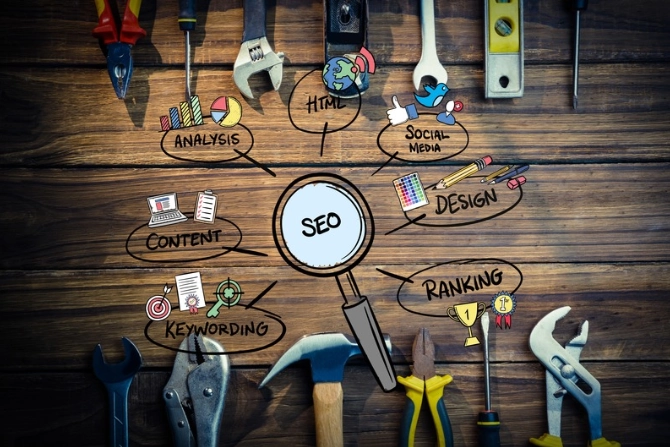
On-Page SEO: Content & Page Optimization
On-page SEO refers to all the activities you perform directly on your website and its content to ensure that both search engines and users can clearly understand that content.
Keyword Research: Keyword research is the foundation of on-page SEO. Its purpose is to identify the terms that people enter into search engines:
1. Short-tail keywords: Phrases consisting of 1 or 2 words (e.g., “SEO,” “shoes”). These have a high search volume, but ranking for them is highly competitive.
2. Long-tail keywords: Phrases consisting of 3 or more words (e.g., “complete guide to SEO in Hindi,” “best running shoes for men”). These have lower competition and higher conversion rates.
Title Tags and Meta Descriptions:
1. Title Tags: These are the clickable blue headlines that appear on the SERP (Search Engine Results Page). Include your primary keyword near the beginning, and keep the length between 50 and 60 characters.
2. Meta Descriptions: This is a summary snippet of 150–160 characters that appears below the headline. It should be engaging to encourage users to click, thereby boosting your CTR (Click-Through Rate).
Heading Structure (H1, H2, H3): Content should be clear and easy to scan:
1. Each page should have only one H1 tag, which represents the main heading.
2. Use H2 tags for core sections.
3. Use H3 and H4 tags for sub-points or secondary sections.
Keyword Placement and Density Incorporate your focus keywords naturally in the following places:
1. Within the URL.
2. In the first 100 words of the content.
3. In at least one H2 heading. • Integrate keywords naturally into the content (maintain a keyword density of 1% to 1.5%).
4. Include alt text for the featured image.
Content Quality and User Intent: Google prioritizes helpful content. The article should fully satisfy the user’s search intent (informational, transactional, or navigational). Ensure the text is easy to read by using short paragraphs, bold text, and bullet points.
Image Optimization Large, heavy images slow down website speed:
1. Always use lightweight formats such as WebP.
2. Keep file names clean (e.g., `what-is-seo-guide.webp`).
3. Include descriptive alt text for every image so that crawlers can understand the image context.
Internal and External Linking:
1. Internal Links: Link your new post to relevant older articles or blog posts on your website. This facilitates the flow of authority and helps reduce the bounce rate.
2. External Links: Link to high-authority, credible resources to support your data points or facts.
Technical SEO: Backend & Site Architecture
Technical SEO ensures that search engine bots can crawl and index your site without any obstacles.
1. Page Speed and Core Web Vitals:
Slow sites are disliked by both users and Google. Key parameters of Core Web Vitals must be optimized:
• LCP (Largest Contentful Paint): The main content should load within 2.5 seconds.
• INP (Interaction to Next Paint): Button clicks and page response times should be ultra-smooth.
• CLS (Cumulative Layout Shift): Elements should not shift from their positions while the page is loading (the score should be less than 0.1).
2. Mobile-Friendly Responsive Design:
More than 60% of global search traffic comes from mobile devices. Google follows mobile-first indexing; therefore, the mobile version of a website must be clean, responsive, and easy to navigate.
3. SSL Certificate (HTTPS):
Data encryption and security are fundamental ranking signals for Google. The site URL should include “https://” and display a secure padlock icon to maintain user trust.
4. XML Sitemap and robots.txt:
• XML Sitemap: A structured map that informs search bots which pages to index.
• robots.txt: A file that provides instructions to search engine bots, specifying which website folders (such as admin panels or private files) should not be crawled.
5. Canonical Tags and 301 Redirects:
• Canonical Tag (rel=”canonical”): This identifies the original “master” page for Google, helping to avoid issues related to duplicate content. • 301 Redirect: When a URL changes or is deleted, a 301 permanent redirect is used to safely transfer ranking authority to the new page.
Off-Page SEO: Authority & Backlink Building
Off-page SEO encompasses all the efforts you undertake outside of your own website to enhance its credibility and domain trust within search engines.
1. The Concept of Backlinks:
When another website includes a link to your site, it is referred to as a “backlink.” Google considers every quality backlink to be a “vote of trust.”
2. Quality vs. Quantity:
A single high-authority backlink from a relevant, niche-specific website is far more powerful than thousands of low-quality, automated directory links. Google may penalize a site for purchasing spammy links.
3. Ways to Build Natural Backlinks:
• Guest Posting: Write high-value articles for relevant industry blogs to earn natural links.
• Broken Link Building: Identify dead links (404 errors) on competitors’ websites and suggest your own functional content as a replacement.
• Original Research and Guides: Publish comprehensive data that other bloggers will want to cite as a source.
Local SEO: Optimization For Physical Business
If your business serves a specific city or region, local SEO is the most effective tool:
• Google Business Profile (GBP): Verify your business on Google Maps. Include accurate business hours, contact numbers, and authentic images.
• NAP Consistency: Your Name, Address, and Phone Number (NAP) must be identical across all online directories and local citations on the internet.
• Customer Reviews: Encourage satisfied customers to post positive reviews on your Google profile, and ensure you respond to them regularly.
Top Google Ranking Factors
These key signals have the greatest impact on Google’s algorithms:
1. Content Relevance and Search Intent: The page should provide the most comprehensive solution to the user’s query.
2. Quality Inbound Backlinks: Trust signals derived from reputable, authentic websites.
3. Core Web Vitals and Loading Speed: A fast, seamless user experience.
4. Mobile Optimization: Flawless display across all screen sizes.
5. E-E-A-T Framework: Experience, Expertise, Authoritativeness, and Trustworthiness.
6. User Signals: Low bounce rate, high dwell time, and strong organic CTR (Click-Through Rate).
Best SEO Tools
Industry-standard tools for SEO execution and auditing:
• Google Search Console (GSC): An official, free platform for tracking organic clicks, impressions, keyword rankings, and indexing errors.
• Google Analytics 4 (GA4): For measuring website visitor behavior, traffic sources, and conversion flows.
• Ahrefs / Semrush: For keyword search volume, competitor strategy, backlink monitoring, and technical health scans.
• Yoast SEO / Rank Math: Popular WordPress plugins that provide real-time on-page optimization checks while creating content.
5 Common SEO Mistakes To Avoid
1. Keyword Stuffing: Forcibly inserting keywords repeatedly into an article ruins readability and can trigger a penalty.
2. Buying Backlinks: Purchasing cheap, spammy links can lead to your website being de-indexed.
3. Ignoring Search Intent: If a user is looking for a quick answer and you provide irrelevant information, they will bounce from your site immediately.
4. Duplicate Content: Copying and pasting content from other websites permanently blocks any growth in your rankings.
5. Lack of Consistency: SEO is an ongoing process; rankings cannot be maintained without regular updates and patience.
Step-by-Step SEO Implementation Checklist Follow this streamlined workflow to optimize posts on a new website:
1. Select Target Keywords: Choose long-tail keywords with low competition.
2. Analyze Competitor SERPs: Examine the structure and content coverage of the top 3 ranking pages.
3. Create High-Value Content: Produce the most comprehensive and readable content on the topic.
4. Configure On-Page Tags: Set up the title, meta description, and appropriate H2/H3 headings.
5. Compress Images: Upload images in WebP format, including descriptive alt text.
6. Add Internal Links: Link to at least 3–4 related articles.
7. Submit the URL: Once the article is published, request indexing via the URL Inspection tool in Google Search Console.